
Sessions
Date, delivery mode, trainer and fee are specific to each session. Fees are per person.
Request a quote for a date for your organisation or for the next run.
Application formNo membership required
Get a quote
Training content
Overview
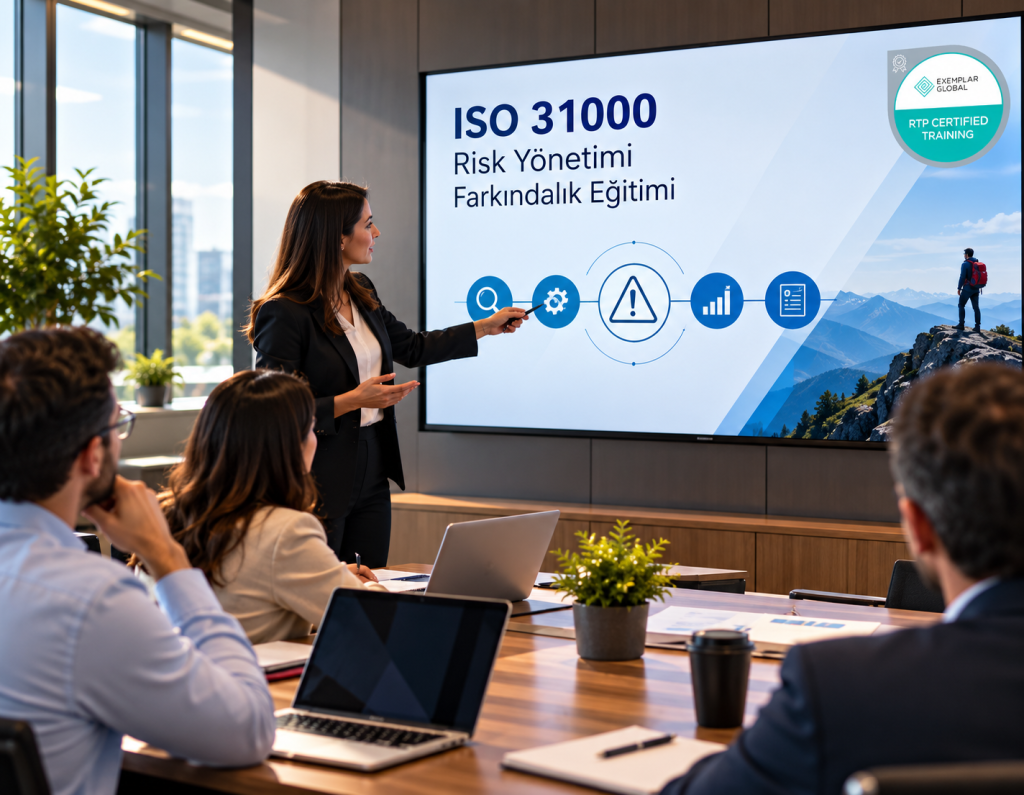
ISO 31000 Risk Management Awareness Training has been designed to develop a risk management culture within organisations, systematically assess uncertainties, and integrate the ISO 31000 principles into day-to-day decision-making and management processes.
The training is based on the current ISO 31000:2018 Risk Management — Guidelines. ISO 31000 provides a systematic approach to identifying, analysing, evaluating, treating, monitoring and reviewing risks that may affect organisations’ achievement of their objectives.
The training is delivered in Turkish. The training is online.
About the Training
The training covers the structure of the ISO 31000 standard, risk management principles, the risk management framework, the risk management process, the context of the organisation, establishing risk criteria, risk identification, risk analysis, risk evaluation, risk treatment options, communication and consultation, monitoring and review, recording and reporting, and the integration of risk management into decision-making processes.
Who Should Attend?
- Employees who wish to learn about risk management
- Managers and heads of department
- Risk and compliance teams
- Quality and management system personnel
- Internal audit personnel
- Finance and operations teams
- Project managers
- Strategic planning teams
- Business continuity and crisis management personnel
- Professionals involved in enterprise risk management activities
Objectives and Outcomes
The aim is for participants to understand the ISO 31000 risk management approach, assess the effects of risks on organisational objectives, understand basic risk assessment methods and apply risk-based thinking in day-to-day decision-making processes.
By the End of the Training
Participants will be able to:
- Explain the purpose, scope and basic structure of the ISO 31000 standard.
- Understand the concepts of risk and uncertainty.
- Explain the principles of risk management.
- Identify the key components of the risk management framework.
- Assess the organisation's internal and external context.
- Understand how risk criteria are established.
- Identify risks systematically.
- Explain the difference between risk analysis and risk evaluation.
- Apply the likelihood and impact approach.
- Evaluate risk treatment options.
- Understand the concepts of risk ownership and responsibility.
- Explain the importance of monitoring and reviewing risks.
- Assess how risk management contributes to decision-making processes.
Programme and Method
Training Topics
- Introduction to the ISO 31000 Standard and Risk Management
- Concepts of Risk, Uncertainty and Opportunity
- ISO 31000 Risk Management Principles
- Establishing the Risk Management Framework
- Leadership, Commitment and the Integration of Risk Management
- Determining the Organisation’s Internal and External Context
- Establishing Risk Criteria
- Risk Identification
- Risk Analysis and Determination of Risk Levels
- Risk Evaluation and Prioritisation
- Risk Treatment Options and Action Plans
- Risk Ownership, Responsibilities and Authorities
- Communication and Consultation
- Monitoring, Review, Recording and Reporting
- Integration of Risk Management into Decision-Making and Continual Improvement Processes
Training Method
The training is delivered through topic presentations, risk identification exercises, likelihood and impact assessments, risk matrix exercises, evaluation of risk treatment options, sample risk registers, case studies and examples from day-to-day business processes.
Attendance and Certificate
Certification Rule
A certificate of attendance is issued to all participants whose attendance has been confirmed. To receive a certificate of achievement, participants must achieve a passing grade in the examination at the end of the training; participants who use all their examination attempts but do not pass will be issued a certificate of attendance.
FAQ and Resources
Who is the ISO 31000 Risk Management Awareness Training suitable for?
It is suitable for all employees and managers working in risk management, strategic planning, quality, finance, operations, project management, internal auditing, compliance and management systems, or those wishing to gain a basic understanding of risk-based thinking.
What is the main objective of the training?
The main objective is to enable participants to understand the fundamental principles of risk management, assess risks systematically and apply a risk-based approach to decision-making processes.
What areas does ISO 31000 cover?
ISO 31000 covers risk management principles, the risk management framework, establishing the context, risk identification, risk analysis, risk evaluation, risk treatment, communication, consultation, monitoring, review and reporting processes.
Which organisations is ISO 31000 intended for?
ISO 31000 can be applied in public, private-sector and not-for-profit organisations, regardless of their size, sector or field of activity. It can also be used to manage different types of risk, including strategic, operational, financial, project, quality, environmental and occupational health and safety risks.
What is the difference between risk analysis and risk evaluation?
Risk analysis aims to understand the nature, sources, consequences and likelihood of a risk. Risk evaluation involves comparing the analysis results against established risk criteria to determine whether the risk is acceptable or whether additional action is required.
What is risk treatment?
Risk treatment is the process of identifying and implementing options such as reducing the risk, removing the risk source, changing the likelihood or consequences, sharing the risk, accepting the risk or pursuing a specific opportunity.
Is a risk matrix mandatory under ISO 31000?
No. ISO 31000 does not require a specific risk assessment method. A risk matrix is one of the commonly used methods; an organisation may use different methods suited to its objectives, context and the nature of its risks.
Does the training include practical exercises?
Yes. The training includes risk identification, likelihood and impact assessment, risk matrices, risk treatment options, sample risk registers and case studies.
Is there an examination at the end of the training?
Yes. An assessment examination is administered at the end of the training.
References
- ISO 31000:2018 Risk Management — Guidelines
- ISO 31010:2019 Risk Management — Risk Assessment Techniques
- ISO Guide 73:2009 Risk Management — Vocabulary
- ISO 22301 Security and Resilience — Business Continuity Management Systems
- ISO 37301 Compliance Management Systems — Requirements with Guidance for Use
- ISO 19011:2026 Guidelines for Auditing Management Systems
Similar trainings
EXEMPLAR037ISO 37001 Anti-Bribery Management System Auditor Training24 hours · No session plannedEXEMPLAR030ISO 37001 Anti-Bribery Management System Awareness Training8 hours · No session plannedEXEMPLAR023ISO 37001 Anti-Bribery Management System Internal Auditor Training16 hours · No session planned